Sixty years of data show inflation moving in step across the world. Economic theory still treats it as a national affair.
Ask an economist where inflation comes from and you will hear about a country: its labor market, its fiscal stance, its central bank. Ask the data and you will get a different answer. Figure 1 shows consumer price inflation in eleven advanced economies over more than sixty years. It is, to a first approximation, one line drawn eleven times. The great inflation of the 1970s, the long quiet that followed 1990, the surge of 2021 and its retreat: every country lived them together, whatever its institutions, its policies and its governments.
Figure 1. Consumer price inflation, selected advanced economies, 1960–2023 (annual %).
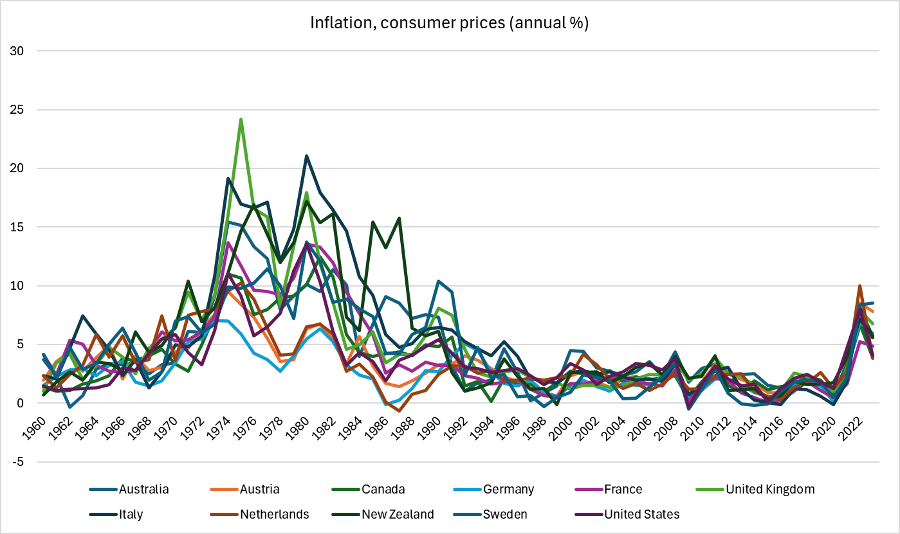
Source: World Bank data; Figure 1 of the working paper.
The standard way to accommodate this fact is the common shock. Oil in 1973, the pandemic and the war in 2021: the world occasionally hits every economy at once, and national inflations move together because their disturbances do. Shocks are real and they matter; nobody who lived through 2022 in Europe needs convincing that energy prices can move a price level. But the synchronization did not begin with the pandemic, and it does not fade between emergencies. Inflation rates co-moved tightly through the calm decades too, when there was no world-historical event to blame. An explanation that must be summoned fresh for every episode is less a theory than an alibi.
In our new INET Working Paper, we argue that the problem lies deeper, in what we call the methodological nationalism of inflation theory. Our theories, whether monetarist, Keynesian or conflict-based, describe a domestic process occasionally disturbed from outside. Even the literatures that take the world seriously cannot shake the habit. Studies of “imported inflation” and exchange-rate pass-through treat the international economy as a shock hitting an otherwise national process. The “globe-centric” view developed at the Bank for International Settlements goes the other way and estimates Phillips curves for the planet, with global slack driving national prices. One approach shrinks the world to a disturbance; the other stretches the country until it covers the globe. Neither asks what happens between countries.
Our proposal is to study inflation as the outcome of the interaction among open economies: a cohesive international phenomenon, as Salvatore Biasco called it in the 1970s, rather than a sum of national stories. The grammar is simple. Shocks and structural changes move relative prices. Whether they turn into sustained inflation depends on who has the power to resist the implied redistribution: workers and firms, debtors and creditors, deficit and surplus countries. And that power is distributed internationally. In the paper we illustrate three mechanisms, one for each of the classic loci of inflation theory (see table).
The three mechanisms discussed in the working paper.
| As a domestic story | Recast internationally |
Labor market | Wages and bargaining power set costs | Capital mobility and value chains reshape bargaining power everywhere at once |
Real market | Demand and supply move prices | Surplus countries anchor tradable prices, capping inflation elsewhere |
Money and finance | Monetary policy sets liquidity | Global liquidity reaches commodity and asset prices across borders |
In the labor market, global value chains and free capital movement have changed who can leave the bargaining table. Relocation is a credible threat for firms in a way it has never been for workers, and decades of offshoring and global competition have weakened labor’s ability to defend real wages, in the advanced economies above all. Consistently, in the paper we find a robust association between capital-account openness and lower inflation across countries, while the role of union density is weaker and more context-dependent. It is the international mobility of capital, more than the domestic strength of labor, that appears to set the room for wage-driven inflation.
In money and finance, the global financial cycle moves credit, asset prices and risk appetite across borders at once. Commodity markets sit at the crossing point: oil, gas and food are at the same time production inputs and heavily traded financial assets: their prices are made in financial markets before they are made in physical ones. When global liquidity is abundant, and it increasingly flows through non-bank intermediaries and derivatives rather than banks, it can reach the cost structure of every economy simultaneously, with no national demand pressure required. In the paper we document how measures of global liquidity and financial activity have co-moved with energy and food price indices over the past two decades.
The third mechanism concerns the real market. Textbook theory says that flexible exchange rates should insulate countries and offset inflation differentials. Four decades of data say otherwise: real effective exchange rates have drifted far less than the theory requires. Meanwhile, as Figure 2 shows, export prices have risen systematically more slowly than consumer prices across the major economies. Prices of tradable goods, we suggest, are anchored by a small group of persistent surplus countries (Germany, Japan and China above all) that defend their competitiveness and thereby impose a ceiling on international prices, and hence on everyone else’s inflation. Deficit countries cannot complete the adjustment by deflating, because nominal prices resist falling; they adjust through income and output instead. The result is a structural deflationary bias in the world economy, the very asymmetry Keynes tried to correct at Bretton Woods with his proposal of an International Clearing Union. During the Great Moderation, central bankers took credit for a discipline that was in good part structural. When the pandemic pushed those anchor countries into fiscal expansion and faster wage growth, the ceiling lifted, and global inflation returned.
Figure 2. Ratio of the export price index to the consumer price index, selected economies, 1980–2022. A declining ratio means export prices rising more slowly than consumer prices.
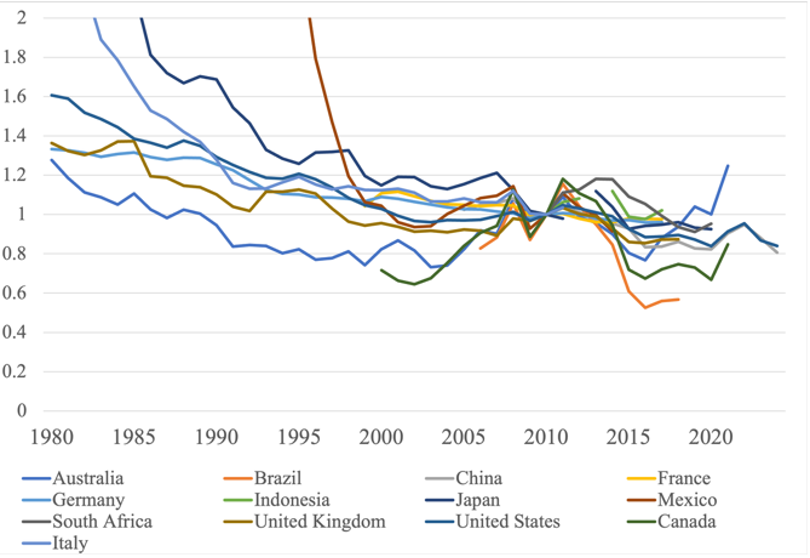
Source: Figure 3, panel (b), of the working paper.
We present all of this as a research agenda, not a verdict. The empirical difficulty is stark: under standard methods, a world of common shocks and a world of interacting economies look almost identical, because the time effects that capture the common component of inflation absorb both. Telling them apart will require exploiting how differently exposed countries respond (the cross-sectional structure that a pure common shock cannot generate). The paper spells out the hypotheses, and what would count against them. The clearest test concerns the anchors: if Germany, Japan and China return to their traditional low-inflation regimes and a ceiling on global inflation visibly re-emerges, our reading gains support; if global inflation instead tracks common shocks regardless of their stance, it loses.
The stakes are more than academic. If inflation is made between countries as well as within them, then instruments designed for one country at a time are partly miscast. The recurring spectacle of central banks tightening in lockstep, each defending its own currency against the others, is individually rational and collectively self-defeating; the same logic runs through commodity markets, where no single importer can tame prices that are set globally, and through an adjustment burden that falls on deficit countries alone. What is missing is coordination between countries: over monetary policy, over the regulation of commodity and financial markets, and over how the costs of adjustment are shared. The fault lies with the rules of the game more than with any individual player. For fifty years we have asked what each country does to its own prices. It is time to ask what countries do to each other’s, and what they could do together.