NVIDIA’s $150 billion buyback plan raises the question of who benefits when corporate cash is spent propping up share prices. Behind the AI boom lies a system that rewards executives and investors while starving productive investment and weakening resilience.
The SEC’s license to loot
On September 28, NVIDIA announced that its board had authorized a new $150-billion share repurchase program, to be completed by the end of January 2029. That was in addition to $85 billion that could still be repurchased under Nvidia’s previous authorization. Going forward, NVIDIA CEO Jensen Huang and CFO Colette Kress can, at their discretion, instruct the company’s broker to do stock buybacks as open-market repurchases in amounts and on days of their choosing. If they decide to repurchase all $235 billion currently authorized over the next 28 months, the company’s record-breaking buyback rate will be $101 billion annually.
The Securities and Exchange Commission (SEC) does not require disclosure, even after the fact, of daily or weekly data on actual open-market repurchases. We can assume that NVIDIA’s general counsel, Tim Teter, will ensure that the execution of the buybacks complies with the stipulations of SEC Rule 10b-18 (adopted in November 1982) so that NVIDIA and its senior executives can avail themselves of the Rule’s “safe harbor” against stock-price manipulation charges. One of those conditions is that the shares repurchased on any single trading day cannot exceed 25 percent of the average daily trading volume (ADTV) of NVIDIA’s stock over the previous four weeks. On September 28, 2026, the ADTV was $6.6 billion; that is, NVIDIA’s executives could, hypothetically, drain the corporate treasury of the $235 billion in authorized repurchases in just 36 days. Moreover, if NVIDIA wants to repurchase shares through a block trade that would exceed its ADTV, a 2003 revision to Rule 10b-18 permits it to do so once per week, provided that the company does no other open-market repurchases on the same day on which it does that block trade. If NVIDIA’s senior executives decide to “disgorge” the $235-billion authorization quickly, the board can always come back with a new authorization, just like they did last month.
If it appears that Rule 10b-18’s safe harbor permits NVIDIA’s executives to manipulate the company’s stock price with impunity, that is precisely what the Rule does. Adopted by President Ronald Reagan’s SEC, for the past 44 years Rule 10b-18 has provided senior executives of publicly listed U.S. business corporations with a “license to loot” the corporate treasury. Our research group, the Academic-industry Research Network (AIRnet), has calculated that the 216 companies in the S&P 500 Index in January 2020 that were publicly listed from 1981 through 2019 distributed 49.7 percent of net income as dividends and 4.4 percent as buybacks in 1981–1983, but spent 49.6 percent of net income on dividends and 62.2 percent on buybacks in 2017-2019. Many companies, for years on end, distribute more than 100 percent of profits as dividends and buybacks by, for example, taking on debt, reducing cash reserves, divesting assets, and/or downsizing the labor force.
Over the five-year period from 2021 to 2025, the 500 industrial corporations listed on either NYSE or NASDAQ with the highest revenues in each year did $4.9 trillion in buybacks, equal to 49.7 percent of their combined net income, along with $3.5 trillion in dividends, representing another 35.7 percent of net income. In a large and growing body of work, AIRnet has shown that stock buybacks are a prime source of concentration of income and wealth among the very richest American households, while they undermine U.S. competitiveness in a range of critical technologies and erode employment opportunities for most of the population. In our view, one cannot address the “affordability” crisis in the United States without recognizing the damage to the economy wrought since the mid-1980s by trillions upon trillions of dollars in stock buybacks by the nation’s largest, and often most profitable, corporations.
The largest repurchasers among industrial corporations in 2025 were Apple ($90.7 billion), Alphabet ($45.7 billion), NVIDIA ($40.1 billion), Meta ($26.2 billion), Exxon Mobil ($20.3 billion), Microsoft ($14.3 billion), Salesforce ($12.6 billion), Chevron ($12.2 billion), Adobe ($11.3 billion), and HCA Healthcare ($10.1 billion). Fueled with its $150-billion authorization, NVIDIA is now on track to surpass Apple to become the leader of the annual-buybacks pack. Sporting his familiar black leather motorcycle jacket, CEO Huang has been off to the loot-the-corporate-treasury races since 2022 as shown in Figure 1 below. From fiscal 2022 (ended January 29, 2023) through the first half of 2026, as its sales and profits soared with the AI boom, NVIDIA did $132.4 billion in buybacks (an annual average of $29.4 billion), including $39.0 billion in the first half of 2026.
Figure 1. NVIDIA quarterly stock buybacks, $b., Q1 2019 to Q2 2026
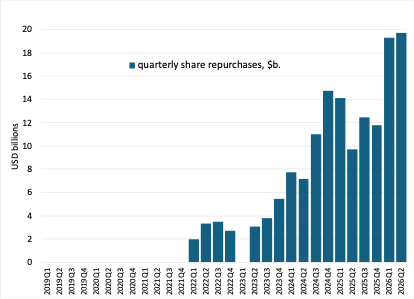
Source: NVIDIA 10-Q and 10-K filings with the SEC.
Return what to whom?
Why is NVIDIA on this buyback binge? In the September 28 press release, founder and CEO Jensen Huang explained: “Our cash generation gives us the capacity to invest in the technologies that advance this transformation and return capital to shareholders. This authorization reflects our confidence in the long-term opportunity ahead.”
There are three separate arguments to unpack and critique in this carefully crafted rationalization. NVIDIA’s “cash generation” means that the company has more money on hand than it needs to fund its present role in the AI revolution. Huang’s “confidence in the long-term opportunity ahead” means that he expects that the company will replenish its buyback-depleted cash reserves for as far as his strategic eye can see (and as a co-founder of NVIDIA in 1993 and its only CEO, no one can accuse Huang of “short-termism”). The “return capital to shareholders” argument is top-management code for NVIDIA’s commitment to “maximizing shareholder value”.
The basis for the “cash generation” part of Huang’s buybacks rationalization is NVIDIA’s $120 billion in net income in 2025 and $118 billion in the first six months of 2026. When the company’s Q3 2026 results become available in mid-November, they will undoubtedly show that in just nine months, NVIDIA’s net income will have surpassed the all-time twelve-month record for a U.S. corporation of $133.7 billion, raked in by Microsoft for fiscal 2026 (ended June 30, 2026). For a reasonable fee, we would be happy to provide Mr. Huang with advice on productive, and possibly profitable, uses of NVIDIA’s cash instead of wasting it on buybacks. We would begin with the suggestion that he consider making $100 billion available to Intel Corporation (which is presently asking shareholders, please, for $15 billion) to invest in semiconductor fabrication, packaging, and assembly capabilities to match those of world-leader Taiwan Semiconductor Manufacturing Company (TSMC). Currently, NVIDIA is completely reliant on TSMC for advanced operations, and that will remain the case unless Intel (once the world’s leading semiconductor fabricator) can implement the capital-intensive and research-intensive investments required to become a viable “second source” of advanced hardware.
In September 2025, after the Trump administration converted $8.9 billion of Biden-era subsidies to Intel (mostly from unpaid CHIPS and Science Act grants) into a 9.9 percent U.S. government equity stake, NVIDIA ponied up $5.0 billion to support Intel’s investment in semiconductor capabilities in return for about four percent of Intel’s shares outstanding. For a semiconductor manufacturer such as Intel that needs to invest in and implement some of the most complex and expensive technologies in existence, $5 billion is diddly squat. Rather than waste $235 billion manipulating its stock price over the next couple of years, Nvidia could be backing the productive transformation of a U.S.-based company that is critical to America’s industrial and geopolitical future.
Our proposed mega-investment in Intel—which, at $100 billion, is on a scale that has become normal for far riskier projects in the AI boom—need not take the form of an equity stake beyond the four percent or so of Intel’s stock that NVIDIA already holds. We suggest that NVIDIA provide its $100-billion to Intel in the form of a perpetual bond, a financial instrument that would give the fabricator the financial commitment that it needs without challenging the strategic control of Intel CEO Lip-Bu Tan and his board. One corporate CEO who understands how to use perpetual bonds to fund massive, but uncertain, investments in productive capability is Chuanfu Wang, co-founder and CEO of China-based BYD, the global leader in the EV transition.
The “long-term opportunity ahead” part of Huang’s explanation may possibly come to pass—but there is a very real possibility that the AI bubble will burst, with NVIDIA’s revenues and profits (and stock price) shrinking in the process. AIRnet has carried out many studies of high-flying U.S. corporations that urinated away their profits on stock buybacks, only to regret it when, some years later, the excrement hit the industrial fan. Among the big buybackers that subsequently found themselves in the toilet are Boeing, IBM, Motorola, Hercules, Pfizer, General Electric, General Motors, and Intel.
As for a buyback addict that remains flush with cash, it is worth contemplating the case of Cisco Systems, whose CEO John Chambers decided at the beginning of the 2000s not to leverage its global leadership in enterprise networking equipment by upgrading Cisco’s capabilities to compete in the more sophisticated service-provider equipment market. Instead, Chambers opted to do buybacks to manipulate the company’s stock price. From October 2002 through July 2015, when Chambers stepped down as CEO, Cisco did $93 billion in buybacks—equal to 101 percent of net income—while he ceded global leadership in service-provider equipment to China-based Huawei Technologies—which, by the way, has become NVIDIA’s most formidable competitor in the AI-chip market.
CEO Huang should also consider the history of Intel, whose $150 billion in buybacks under five CEOs from 1993 to 2020, equal to 61 percent of net income, ultimately resulted in the erosion of the company’s innovative fabrication capabilities—which is why the former icon of American industry needs massive assistance now. When Pat Gelsinger, who (among other accomplishments) had been the chief architect of Intel’s 80486 microprocessor in the late 1980s, agreed to become Intel’s CEO in February 2021, he told the board: “We’re done with buybacks. We are investing in factories”. Unfortunately for Mr. Gelsinger, in the process of implementing his IDM 2.0 investment strategy, he became the face of President Biden’s CHIPS and Science Act. Intel’s board forced him to retire on December 1, 2024, less than four weeks after Trump recaptured the White House.
Speaking of grifters, that brings us to the third part of Huang’s buybacks rationalization, where Huang says that the $150-billion program is being put in place to “return capital to shareholders”. As NVIDIA’s co-founder and sole CEO, Jensen Huang of all people should be aware of the fabrication in this quoted phrase. NVIDIA cannot “return” cash to its shareholders because (except for NVIDIA’s employees) the public shareholders who now hold the company’s stock never gave NVIDIA any capital that the company can “return”. The only times in its history that NVIDIA went to the stock market to raise money to be invested in the company’s productive capabilities were the $43 million (net) raised in its initial public offering (IPO) on NASDAQ on January 22, 1999, and $97 million (net) raised in a secondary issue in 2000. If any individuals who purchased shares issued in 1999 or 2000 still held those shares in September 2026, the increase in the company’s stock price over that time would have provided them with an almost unimaginable return: For example, $1,000 spent to purchase NVIDIA shares in the IPO would have fetched about $9.2 million on NASDAQ in September 2026. Nice work if you were patient enough to get it (ask NVIDIA co-founder Curtis Priem)!
Almost all NVIDIA’s current shareholders, whether retail or institutional, have merely purchased outstanding shares already existing on the stock market, without any money flowing to NVIDIA. They are “investors” (with limited liability) in NVIDIA’s highly liquid shares; they have nothing to do with investing in NVIDIA’s innovative capabilities—except when the company risks undermining those capabilities by doing buybacks to “return” craploads of cash to shareholders. Like stock-market traders more generally, NVIDIA’s shareholders get their “returns” by selling their shares to realize gains from the company’s rising stock price, which (in case you missed it) has been on a spectacular rise since the end of 2022 (see Figure 2). While holding shares, they also receive quarterly dividends, which the company has been paying since 2012. With NVIDIA’s stock price being driven by a combination of innovation and speculation, there is no need to further reward these rentiers by spending hundreds of billions of dollars on stock-price manipulation so that they realize even higher gains when they sell shares.
Figure 2: NVIDIA adjusted close stock price, January 1999-September 2026
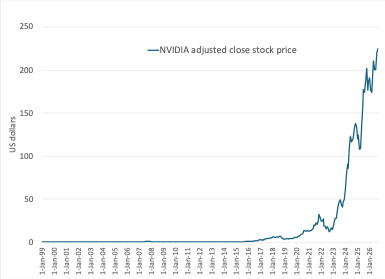
Source: Yahoo! Finance, NVDA monthly stock prices.
Since NVIDIA went public in January 1999, the company has received $29.2 billion from employees when, as part of stock-based compensation programs, they pay exercise prices on stock options or purchase shares at a discount. That amount is offset, however, by $24.2 billion in cash that, since 2010, has provided for withholding taxes on the realized gains from vested stock awards (aka restricted stock units), as the company reclaims shares from the vested stock awards equal to the market value of the income taxes that must be withheld. The purpose of this internal exchange of shares for cash is to enable employees to hold on to their vested shares rather than selling them into the stock market to finance their withholding taxes.
In April 2024, CEO Huang gave NVIDIA employees a “special Jensen grant” that increased their annual stock awards by 25 percent. At the same time, in a surging stock market, Huang has reason to worry about employee turnover and, for those who stay, a sagging work ethic, both of which can occur when, through their stock-based pay, employees become too rich too fast. On these issues, Huang might want to talk to Bill Gates about his experience as leader of Microsoft in the Internet boom of the late 1990s and 2000.
Dilution confusion
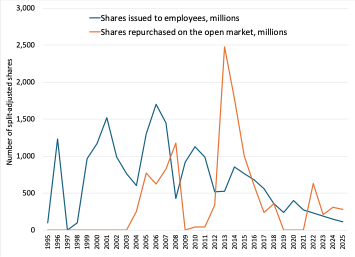
Our rejection of CEO Huang’s arguments in the company’s $150-billion buyback press release does not mean that we are done with the lame reasons that NVIDIA’s senior management has proffered for doing large-scale open-market share repurchases. In the company’s 2025 Annual Review, twice, under the subheadings “Capital Return to Shareholders” (p. 44) and “Capital Return Program” (p. 77), NVIDIA’s management repeats an argument made by many companies with broad-based stock-based compensations plans: “Our share repurchase program aims to offset dilution from shares issued to employees while maintaining adequate liquidity to meet our operating requirements. We may pursue additional share repurchases as we weigh market factors and other investment opportunities.” Figure 3 shows that the two series of the number of shares that NVIDIA has issued for stock-based compensation and the number of shares repurchased on the open market display very different patterns over time. There is no obvious correlation between the decisions to do share repurchases on the open market and share issues to employees from stock-based plans.
Figure 3. NVIDIA shares issued to employees and repurchased on the open market, 1995-2025
Source: NVIDIA 10-K filings with the SEC, 1995-2025
There is, however, a more fundamental point to be made about this rationalization of the company’s buybacks. As a senior executive who built the company from a startup in 1993 to the global phenomenon that it is today, Jensen Huang must know that there is no logic to the “offsetting dilution” argument as a justification for open-market repurchases. The point of stock-based compensation is to incentivize employees to work harder and smarter to generate innovation; that is, to create the higher-quality, lower-cost goods and services that can give the company a sustained competitive advantage on its product markets.
When, through the employees’ “collective and cumulative learning”, the company is successful in generating innovative products, the increases in sales and profits lead stock traders to bid up the company’s stock price after-the-fact. Adding to the innovation-induced price rise is often a price boost that occurs as stock traders speculate that the company’s success in product-market competition will continue in the future. Shareholders who want to realize gains on the stock-price increase that results from innovation and speculation can, if they so choose, sell shares, thus benefiting from the value created by NVIDIA’s employees. What is the logic of doing buybacks so that public “sharesellers” (who, in any case, create no value for the company) can realize an additional gain from the execution of buybacks to manipulate the company’s stock price? We think that, deep down in his managerial heart, Mr. Huang knows the answer to that question.
So why does NVIDIA do buybacks?
Now that we have debunked Huang’s own reasons for wasting hundreds of billions of dollars on buybacks, it is time that we reveal the secret of NVIDIA’s excess. We have saved the valid explanation for last because it is based on two inter-related reasons which CEO Jensen Huang, CFO Collette Kress, and GC Tim Teter would never mention.
The first is an obvious one, which was central to a well-known Harvard Business Review article entitled: “Profits Without Prosperity: Stock Buybacks Manipulate the Market and Leave Most Americans Worse Off”, published in 2014. The stock-based compensation of these senior executives gives them a financial incentive to do buybacks to inflate their take-home pay. For the years 2006-2025, Huang’s money-in-the-bank remuneration totaled $2.396 billion (an annual average of $119.8 million), of which 97 percent was from the exercise of stock options and the vesting of stock awards. For Kress, for 2014-2025, the total was $356 million (annual average, $29.7 million, 94 percent); and for Teter, for 2017-2025, $199 million (annual average, $22.1 million, 95 percent).
Perhaps the reader is thinking that these already super-rich and powerful corporate executives cannot possibly be so greedy as to throw away hundreds of billions of the corporation’s dollars on buybacks just to inflate, through stock-price manipulation, their own compensation. In NVIDIA’s case, their pay would be bounteous because of stock-price increases driven by the company’s innovation and the stock market’s speculation. Where there is greed, however, there is power, and they feed off each other. Stock-based executive pay is just the carrot. The stick is the possibility that a corporate predator known as a “hedge-fund activist” will, with the backing of institutional shareholders, be able to strip you of both your lucrative pay and your corporate power by ousting you from your senior-executive job.
Jensen Huang and his top-management team do not enjoy the job protection that can be provided by dual-class shares. At NVIDIA, ownership of one common share entitles holders or their proxies to one vote in the election of directors to the corporation’s governing board (note that, for reasons that we will explain in future articles, both Alphabet and Meta do massive open-market repurchases despite having dual-class shares that protect the strategic control of their founders). NVIDIA’S first proxy statement after its January 1999 IPO documents that, on April 30, 1999, venture capitalists and related parties held 36.6 percent of the shares beneficially owned (SBO) and the three co-founders (Chris Malachowsky along with Huang and Priem) owned 30.7 percent. A year later, however, the only parties with more than five-percent SBO were Huang (8.7 percent), Priem (9.4 percent), and Malachowsky (6.5 percent). By 2003, it was only Huang with 7.1 percent, which by March 23, 2026, had declined to 3.6 percent. That 3.6 percent shareholding makes Jensen Huang one of the world’s wealthiest people. But it affords him no protection from a hostile boardroom coup.
The 2020 book, Predatory Value Extraction: How the Looting of the Business Corporation Became the US Norm and How Sustainable Prosperity Can Be Restored, co-authored by William Lazonick and Jang-Sup Shin, documents how legal and regulatory changes between the late 1980s and the early 2000s empowered a hedge-fund activist holding, say, one percent of a publicly listed corporation’s outstanding shares, to line up enough proxy votes from institutional shareholders to pose a credible threat to the strategic control of incumbent managers (see also Shin’s elaboration on the evolution of this corrupt proxy-voting system in a subsequent essay, and our recent article on the process of predatory value extraction at General Motors).
Unpublished research that we have done on Intel reveals that from the late 1980s, with insider SBO about twice what Huang currently possesses at NVIDIA, Gordon Moore as chairman and Andrew Grove as CEO made a series of governance changes and allocation decisions designed to protect the company from corporate predators. Yet, as is also the case with NVIDIA, there was no overt attack on their positions of strategic control. Moore and Grove proactively did stock buybacks to forestall a potential attack. In 1998, as Grove was transitioning from chairman to CEO, Intel was blowing $6.8 billion on buybacks (112 percent of its net income)—second only to IBM in that year. From our study of the process of U.S. corporate financialization more generally, we have concluded that in the 1990s, in the name of “maximizing shareholder value”, U.S. corporate governance began to operate like a mafia protection racket. Stock buybacks served as the predators’ favored payoff currency, and senior executives complied by looting the corporate treasury, with their own stock-based compensation serving as a lucrative rake-off for their participation in the racket.
Corporate predators crave stock buybacks because they are in the business of timing the buying and selling of shares to make money out of money. Dividends are paid equally to all holders of a class of shares, with the shareholders having an interest in leaving corporate management with substantial retained earnings to reinvest in the revenue-generating capabilities that can yield profits to sustain the stream of dividends. The realized gains from buybacks, however, go to “sharesellers”, increasing the incomes of the wealthiest households, who now possess even more “capital” to make money out of money. Some of those realized gains from buybacks augment the “war chests” of hedge-fund activists, making corporate managers even more fearful of their power in a contest (actual or imagined) for corporate control. Some of the realized gains inflate the take-home pay of senior corporate executives, serving as a personal sweetener as, enabled by Rule 10b-18, they loot the corporate treasury.
Above all, by participating in this protection racket, Huang and team get to keep their jobs. A “perk” of Huang’s willingness to “maximize shareholder value” is his seat to the immediate right of the grifter-in-chief, as pictured in a New York Times article covering a tech bros’ White House lunch on September 29. CEO Huang’s willingness to plunder the corporation gives him the privilege of paying homage to the man who has mastered the pillaging of the nation.
Ban buybacks
There is an easy solution to this problem of corporate financialization. Ban stock buybacks as open-market repurchases. There is already legislation called the Reward Work Act that has been introduced in the U.S. Senate and U.S. House of Representatives. It calls for the rescinding of SEC Rule 10b-18 and the election of one-third of the directors on corporate boards to represent the interests of employees. When the 120th Congress convenes on January 3, 2027, Democrats, holding majorities in both the Senate and the House, should be aware that, in the 44 years since Rule 10b-18 was adopted, it has never been vetted in Congress.
Hearings on the issue would easily support the proposition that stock buybacks as open-market repurchases enabled by Rule 10b-18 have been an unmitigated disaster for the U.S. economy. The rescission of Rule 10b-18 would strip corporate executives of their safe harbor against charges of stock price manipulation, and, as if by an invisible hand, bring stock buybacks as open-market repurchases to an abrupt halt.
Next up would be consideration of corporate governance reform, in line with the Business Roundtable’s 2019 Statement on the Purpose of a Corporation to deliver value to all stakeholders, that would radically reconstitute board representation. For us, the guiding principle in the selection of corporate directors should be a candidate’s commitment to “progressive value creation” and opposition to “predatory value extraction”.