A case for tackling the corporate machinery driving extreme wealth, and the reforms that could truly curb it.
Targeting billionaires with California’s proposed wealth tax is an eye-catching idea, but perhaps the real problem is how some of these people become billionaires in the first place.
California has long eyed taxing the ultra-rich. In 2024, Assembly Bill 259, backed by progressive Democrats and unions like the California Federation of Teachers, sought annual wealth taxes but was blocked by centrist Democrats, business groups, and Governor Newsom.
Now, advocates are going for a one-time 5% levy on roughly 200 billionaires, covering everything they own — stocks, businesses, art, private islands, personal spacecraft, even intellectual property – basically the whole enchilada if they were state residents on January 1, 2026. SEIU United Healthcare Workers West estimates the tax could raise $100 billion for health and social services.
Backers call it a fair share. Critics cite economic, legal, and retroactive risks.
To many, the logic seems straightforward: billionaires have absurd, even toxic amounts of money. The richest 1% now own more than the bottom 90% combined. Economists Emmanuel Saez and Gabriel Zucman note that middle- and working-class Americans often pay higher effective tax rates than the super-rich, whose California fortunes grew over $2 trillion in just a few years.
Why not tax them?
But Here’s the Twist
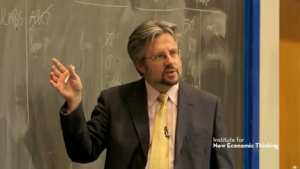
Economist William Lazonick, a long-time critic of the way many U.S. corporations are run, argues that targeting individual fortunes treats the symptom, not the disease. The real engine of inequality is structural: corporate and financial practices that concentrate wealth among shareholders while short-changing other stakeholders who should be benefiting from corporate profits — and too often creating little of real value to society.
Most billionaires don’t “earn” their fortunes through work. They build wealth by owning stock in corporations. Executives and boards pump up dividends and stock prices, often using stock buybacks, which rocket their own pay into the stratosphere. Managers and professionals with stock options or stock awards can cash in too – but only if they keep their jobs. Everyone else — most workers and the wider public that depends on taxing corporate profits to fund schools, roads, and healthcare — gets left behind.
This shareholder-first model (famously called “the dumbest idea in the world” by former GE CEO Jack Welch), encourages executives and investors to treat companies like giant ATMs, pulling money out rather than reinvesting profits to create lasting value.
Consider Mark Zuckerberg. Nearly all of his mind-boggling fortune—the kind that just bought him a record-smashing $170 million mansion in Miami-Dade County near Jared Kushner and Ivanka Trump, and is funding a bombproof bunker/complex in Kauai that disturbs local wildlife —comes straight from owning stock in Meta Platforms. Meta has spent nearly $200 billion on stock buybacks in the past five years. Those buybacks have fattened the wallets of shareholders, including Meta’s top executives and professionals, while leaving the rest of society out of the gains (Meta is famous for its tax-dodging schemes). With Meta, there aren’t any hedge-fund activists forcing Zuckerberg to do buybacks – they’re happening by choice.
Lazonick points out that “with all the profits that they have, they could be creating stable, high-paid jobs for the workers whom they employ—and thereby put in place powerful social conditions for collective and cumulative learning.” He adds, “Instead they are using stock-based pay, which is always volatile and which results in unstable and inequitable employment, to compete for talent.”
Now, even some of Meta’s highest-paid employees are feeling the squeeze. With stock-based pay being cut back and the AI revolution changing work, some of the people who once seemed untouchable are discovering that their jobs aren’t as secure as they thought.
Then there’s Tim Cook. Much of his wealth comes from stock-based compensation tied to the stock-market performance of Apple Inc. Under his leadership as CEO, Apple’s so-called “Capital Return Program” has spent hundreds of billions on stock buybacks – north of half a trillion dollars when counting programs from the early 2010s on — which have helped push up the share price and richly rewarded executives and shareholders. Lazonick has criticized this trend, arguing that Apple’s huge buybacks reward shareholders who have never provided finance to the company, instead of investing in value-creating workers who are the source of innovation. This is the activity that has Cook extremely rich—though he still buys his underwear on sale at Nordstrom, so it’s not entirely clear why he needs all this money.
His workers could sure use a bigger cut. It is a fact that many of the workers who build, sell, or support Apple products have faced stingy pay and labor issues: some retail employees have pushed for higher minimum wages and better benefits as recently as 2022, and labor-rights groups have documented low wages and complaints about conditions among Apple’s supply-chain workers.
A one-time CA wealth tax might dent the personal fortunes of the Zuckerbergs and Cooks, but it does nothing to slow the corporate machinery that grinds on to produce still more of them.
Historically, reformers recognized this issue. For example, Thorstein Veblen critiqued the ways elites could extract wealth while contributing less to society than might be expected. And early 20th-century progressives championed higher corporate taxes and antitrust laws because they understood that inequality was more structural than individual.
This is what 19th-century critic John Ruskin had in mind when he coined the term “illth.” For Ruskin, true wealth, or “weal,” promotes everyone’s health and prosperity. Illth, by contrast, amasses when money is extracted or hoarded without focusing on social value. Stock buybacks and ownership stakes that line-the pockets of executives at the expense of employees, communities, or innovation are a modern form of illth.
We don’t want illth.
Taylor Swift Isn’t the Problem
Now let’s bring in someone we can all relate to — Taylor Swift. Her fortune comes from her creativity, work, and audience engagement. She writes songs, records albums, tours, sells merchandise, and negotiates brand deals. Yes, corporate structures like Ticketmaster’s oligopoly complicate matters — but Swift herself isn’t the CEO of a company extracting illth through financial engineering. Taxing her personal wealth dramatizes the issue without addressing its source.
Policies aimed at corporate engines of inequality, rather than individual fortunes, could reshape the system itself. Lazonick and others have recommended a variety of approaches:
· Ban stock buybacks and suppress predatory value extraction. This curbs wealth concentration at the top.
· Encourage employee ownership or provide employee representation on corporate boards. Gains should benefit a broader group of stakeholders – not just shareholders.
· Reimagine corporate governance. Move towards stakeholder models balancing shareholder yields with social and environmental responsibility.
And last, but not least:
· Strengthen progressive corporate taxation. Close loopholes that allow extreme wealth accumulation.
As Lazonick sees it, whether it happens at the federal, state, or local level, government, policy should focus on curbing predatory value extraction and promoting what he calls “progressive value creation”—which means passing laws to stop corporations from being looted, a key source of the exploding wealth of the mega-rich. “From this position of regulatory power,” he advises, “we should then decide how the top 0.1% should be taxed.”
The real work, from this perspective, is reforming the structures that concentrate wealth. If we want an economy that fosters health, innovation, and opportunity instead of illth, chasing Taylor Swift won’t cut it. We need to start regulating the corporate engines behind her peers’ billions.