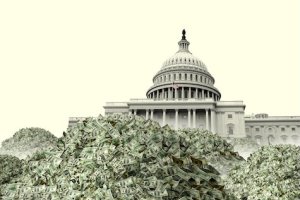
Social Security runs on the paycheck. But a growing share of American wealth now comes from profits, assets, and ownership. The program that ended old-age poverty was never built for an economy that pays people this way.
There is, once again, talk of Social Security “running out of money,” the kind of phrase that surfaces every few years and usually says more about the state of Washington’s nerve than about the state of the program’s finances. Before wading into the financing problem, it is worth pausing on the program’s monumental achievements, because the scale of its accomplishment is easy to forget in the middle of debates about percentages and depletion dates.
Social Security transformed old age in America from a period commonly marked by dependence on children, on charity, or on the poorhouse into one underwritten by a national system of social insurance, and it did so within a single working lifetime. The scale of that transformation shows up in the numbers: recent estimates from the Center on Budget and Policy Priorities find that without Social Security, poverty among Americans 65 and older would exceed 40 percent in nearly a third of states, and that with it, poverty in nearly two-thirds of states falls below 10 percent.
That success is precisely what makes the current debate so charged, because everyone involved understands the stakes. Before weighing the numbers, it helps to be clear about what the trust fund that is predicted to run out actually is. Social Security runs largely pay-as-you-go: today’s payroll taxes fund today’s benefits, and the “fund” holds only the accumulated surplus of richer years, parked in special-issue Treasury bonds. The fund has always been as much a political instrument as a financial one, and Roosevelt built it that way deliberately. When an adviser suggested in 1941 that the payroll tax had been a mistake, FDR agreed on the economics but not the politics: “We put those payroll contributions there,” he said, “so as to give the contributors a legal, moral, and political right to collect their pensions… With those taxes in there, no damn politician can ever scrap my social security program.” The earmarked tax and the named account were meant to make Americans feel they had bought their benefits; that this was their money, not relief; and as it turned out it worked remarkably effectively.
The 2026 Trustees Report dourly projects that the combined trust funds[1] will be “depleted” in the third quarter of 2034, when incoming revenues would still cover 83 percent of scheduled benefits. Looked at on its own, the Old-Age and Survivors Insurance fund is projected to run out even sooner, in late 2032, leaving 78 percent of benefits payable. None of this qualifies as bankruptcy in the conventional sense: payroll taxes will keep flowing in, and checks will keep going out. But a sudden across-the-board cut of one-fifth in retirement income would land on millions of households that have nothing else to fall back on. Private retirement savings in America are concentrated overwhelmingly among people who already have money, which means that for a large share of the population, Social Security is retirement security. There is no other tier underneath it to catch anyone.
Where the Money Went
The usual explanation for the shortfall is demographic, and it is not wrong as far as it goes. The baby boom generation has retired, Americans are living longer, fertility has fallen well below replacement, and the result is fewer workers supporting more beneficiaries than the system’s designers ever anticipated. The 2026 Trustees Report attributes much of the latest deterioration in the numbers to precisely this kind of assumption, particularly lower projected fertility and lower projected net immigration.
But treating demographics as the whole story misses something important about how the program was actually built. Social Security was designed around a specific model of the American economy, one in which most people worked for wages, those wages rose steadily over time, and a payroll tax levied on that wage growth financed the benefits of the generation that came before. It also assumed a largely closed economy, where the rich could not so readily move their money abroad.
In the mid-1930s, when the act was signed into law by President Roosevelt, it was somewhat aspirational. Written in the depths of the Depression, when wages and employment had collapsed far below their 1929 peak, the premise of steadily rising wages was a wager that the long upward trend would resume and continue. For the next forty years the wager largely paid off. Each cohort of workers paid into the same compact it would eventually draw on. The assumption embedded in that design was that the wage base itself would keep growing in step with the economy as a whole. It is that assumption, more than the birth rate, that has quietly stopped holding.
The Social Security Act has never been a static piece of legislation. Congress has repeatedly revised it to respond to changing economic conditions, demographics, and political priorities. The 1935 Act left out roughly half the workforce, including agricultural laborers, domestic servants, the self-employed, and many government and nonprofit employees. These exclusions fell disproportionately on Black and women workers, since a large majority of Black workers at the time were employed in farm or domestic service. Coverage was then extended in stages: most farm and domestic workers and the self-employed were brought in beginning in 1950, with further expansions in 1954 and 1956. The system that now looks close to universal reached that point gradually, by repeatedly widening the base of covered earnings it taxed.
Social Security is financed by payroll taxes on covered earnings, and only up to a cap: in 2026, any wages above $184,500 are exempt entirely, with employees and employers each paying 6.2 percent below that line and the self-employed paying 12.4 percent, half of which is then deductible (Medicare’s separate payroll tax, notably, has no such ceiling). That cap is supposed to rise automatically with average wages, which sounds like it should keep the system’s coverage stable over time. But average wages are not the same thing as the distribution of wages, and when income at the top grows faster than income in the middle, more of the economy’s total earnings simply escape the tax by sailing over the cap. In 1983, after the last major overhaul of the program, roughly 90 percent of covered earnings fell under the taxable maximum; by 2020, according to the Congressional Budget Office, that figure had fallen to about 83 percent. Multiply that seven-point gap across the entire American wage bill and the dollars involved are enormous, which is why the taxable maximum has become central to the policy debate.
The shift underneath that number is larger still, and harder to fix with a single formula. Social Security taxes labor income; it was never built to reach capital gains, dividends, business income, or the unrealized appreciation of assets that increasingly makes up the wealth of people at the top of the distribution. There is plenty of evidence that technology and automation shrink labor’s share of production.[2] Something similar has been happening to the aggregate wage share for decades, technology aside: compensation of employees accounted for 51.9 percent of gross domestic income in 2024, according to the Bureau of Economic Analysis, down from a range more typically in the mid-to-high 50s during the postwar decades.
Economists have, over the years, attributed the decline in wage share to different factors. Duménil and Lévy point to the reassertion of a wealthy capitalist and managerial class under neoliberalism. Lazonick argues that the deeper driver is the rise of a “maximizing shareholder value” model of corporate resource allocation, which since the 1980s has funneled corporate gains toward shareholders and top executives rather than the broad workforce. Of course some of those executive gains are themselves counted as wages in the statistics, so the labor share as measured understates how much the broad workforce has actually lost. Taylor documented roughly eight percentage points of primary income shifting from labor to capital since around 1980, driven above all by what he called wage repression. However one weighs these accounts, they point in the same direction: a growing share of national income now arrives as something other than a wage, and much of what still counts as a wage flows to those at the very top.
The shift is not only between labor and capital but also between here and elsewhere. Globalization rearranges where work happens faster than a system tied to domestic wages can adjust, carrying some share of American earnings beyond the program’s grasp. It is one more way the economy has drifted from the model the program assumed.
None of this converts mechanically into the Social Security shortfall. The actuarial deficit has plenty of causes that have nothing to do with inequality, from interest rate assumptions to disability incidence to the moving 75-year projection window the actuaries use. But a retirement system financed entirely by a tax on paychecks becomes structurally more fragile in an economy where a growing share of the gains show up somewhere other than a paycheck.
The Menu of Fixes
Restoring the taxable maximum to the point where 90 percent of covered earnings are once again subject to tax, phased in gradually between 2026 and 2035, would close about 22 percent of the 75-year actuarial deficit if the newly taxed earnings also earned benefit credit, and about 28 percent if they did not, according to the Social Security actuaries. More aggressive versions of the same idea go further still: applying the 12.4 percent payroll tax to earnings above $250,000, and eventually to all earnings once the current-law cap catches up to that threshold, would close a considerably larger share of the shortfall, with the exact figure again depending on whether the additional taxes generate additional benefits.
The issue of benefits is a critical one, both financially and politically. The current design caps both the tax and the benefit together: pay in on covered earnings, and you earn benefits on those same earnings, nothing more. Kathleen Romig of the Center on Budget and Policy Priorities, along with others who favor lifting the cap, has effectively proposed breaking that link. This would make the program more redistributive and a good deal more solvent, but it also moves away from the earned-benefit self-image that has protected it politically for ninety years. Leaving the link intact, however means much of the solvency gain disappears. Social Security has always lived with that tension. Measured against what people contribute, it treats lower earners more generously than higher ones, and it has never really worked like a private retirement account. Yet almost everyone pays in, and almost everyone expects to collect; a near-universal stake that explains much of why it has lasted.
There is a further distributional wrinkle that makes the cap debate thornier than it first appears. Because the payroll tax reaches only wages and self-employment income, sharply raising or removing the cap falls hardest on high-earning working professionals such as physicians, attorneys, engineers, and small-business owners, while much of the country’s largest fortunes escape almost entirely. The income of private equity and hedge fund principals arrives largely as capital gains and carried interest, which are not wages and never touch the payroll tax at all. A fix built solely on the wage base therefore risks squeezing the salaried and merely affluent while leaving the genuinely rich, whose income flows from capital rather than a paycheck, largely untouched. This is both a political liability and, for a program that depends on being seen as fair, a substantive one.
Congress, of course, has other levers besides the cap. It could simply raise the combined payroll tax rate: the Social Security Administration’s Office of the Chief Actuary estimates that lifting the rate from 12.4 to 16.65 percent starting in 2026 would close the long-range shortfall outright. The trouble is that this raises taxes on the checkout clerk and the surgeon alike, which is why most reform proposals gravitate toward the cap instead. A rate increase also runs into an old feature of the tax that is easy to miss. The payroll tax is formally split between employer and employee, but economists have long held that employers largely shift their half onto workers through lower wages, so that labor ultimately bears most of the burden regardless of who writes the check—an outcome the program’s designers broadly anticipated. That shifting, however, depends on there being wage growth to absorb it, and in an era of stagnant pay the mechanism has very nearly ground to a halt. A higher rate today would be harder to pass discreetly through to workers’ wages and would therefore bite more visibly, part of why raising the rate has become so much more politically fraught than it once was.
Congress could also cut benefits, most commonly by raising the full retirement age, an idea with an appealing one-line justification: people are living longer, so people can work longer. But the premise deserves some scrutiny. Woolf and Schoomaker (2019) found that while US life expectancy rose for most of the postwar period it stalled around 2011 and then actually declined, a trend that only reversed itself several years later. More importantly, perhaps, the gains that did occur are unevenly shared: Bosworth, Burtless and Zhang find that a man born in 1920 in the top tenth of the income distribution could expect to live about five years longer than a man born the same year in the bottom tenth; for men born twenty years later, in 1940, that gap had widened to twelve years. Raising the retirement age treats a warehouse worker, a roofer, a nursing aide, and a delivery driver as though they were living the same actuarial life as a tenured professor with a flexible schedule and better health care, when in fact the people least able to work into their late sixties are disproportionately the people who depend on Social Security the most.
Every one of these options asks some specific, sympathetic group to absorb a visible cost: ordinary workers under a rate hike, the most vulnerable retirees under a later retirement age, high earners under an uncapped payroll tax. That distribution of pain, not any lack of technical solutions, is why meaningful Social Security reform has historically required both parties to share the political risk. The 1983 amendments, built on the Greenspan Commission’s report, combined revenue increases with benefit cuts so that neither party could be blamed alone for the pain, and the deal held for a generation. Nothing like that bargain looks achievable today: Democrats want to protect or expand benefits and pay for it by taxing high earners; Republicans resist new taxes while conceding, in private, that benefit cuts are radioactive. There is renewed talk of a bipartisan commission modeled loosely on 1983, meant to force the issue back into a shared process before the 2032 and 2034 deadlines force it instead. The risk with any commission, though, is that the process itself becomes a substitute for the substance it was created to resolve, because everyone at the table already knows the menu: tax below the cap, tax above it, cut benefits, delay retirement, tap general revenues, bring capital income into the mix. They are all versions of one question nobody wants to answer out loud, namely, “Who pays?”
Beyond the Paycheck
Raising or eliminating the cap addresses the clearest wage-inequality problem embedded in the existing payroll-tax structure, but it leaves a deeper question sitting untouched at the center of the whole debate. If wealth at the top of the distribution increasingly arrives through capital gains, dividends, business ownership, carried interest, rents, and asset appreciation rather than through a paycheck, why should the financing of retirement security remain tied so narrowly to wages in the first place? Medicare already supplies one instructive contrast: its Hospital Insurance payroll tax has no ceiling at all, which does nothing to solve Medicare’s own long-term problems but does establish that Congress has already accepted, in at least one corner of the social insurance system, that taxing wages need not stop at an arbitrary cap. Extending that logic to Social Security could take several forms: taxing investment income directly, as the Sanders-Warren Social Security Expansion Act proposes; treating stock-based compensation more consistently as labor income; or layering in a new revenue source tied explicitly to capital. Any of these would raise genuine design problems, since capital income is more volatile and more mobile than wages. They would raise genuine political problems too, since that income is also more aggressively defended by the people who hold it. But those difficulties are not an argument that the underlying shift in where American income actually comes from will simply reverse itself if Washington looks away for long enough.
Artificial intelligence turns this from a backward-looking accounting problem into a forward-looking one. Acemoglu and Restrepo’s research on automation offers a useful frame here: new technology does not have to eliminate jobs outright to shrink labor’s share of the pie, it only has to automate tasks faster than it creates new ones where human labor has a comparative advantage.
The optimistic case is that AI will complement workers, raise productivity, and open new kinds of work, as electricity and the automobile did after their own bruising transition periods. The more troubling possibility is that it weakens labor’s bargaining position across a much broader swath of occupations at once, and steers a growing share of the economy’s gains toward the owners of capital, data, platforms, and intellectual property, and away from the workers whose paychecks are what Social Security actually taxes. Even short of mass unemployment, that possibility raises the same question the payroll tax cap already raises in miniature: if the productivity gains from AI mostly show up as corporate profits, stock valuations, and executive compensation, the country could grow measurably richer while Social Security’s financing base continues to fall further behind. While the economy would be more productive little of that extra output would reach the wages the tax is levied on. A system built to finance retirement security through the paychecks of a wage-earning population would be operating inside an economy increasingly organized around ownership instead.
America is not too poor to support its elderly; that is the illusion embedded in the phrase “running out of money,” and it obscures the actual question, which is whether the country will keep financing old-age security primarily through the paychecks of workers while a growing share of its gains flow somewhere else entirely. Social Security’s next crisis runs deeper than demographics. The program was built for a wage-centered economy, and it functioned exactly as intended for decades because that was still a reasonably accurate description of how Americans earned a living. If the sources of American income are genuinely shifting away from the paycheck, and the evidence increasingly suggests they are, then the sources of Social Security’s financing will eventually have to shift as well, deliberately and by design, rather than being dragged there by a trust fund deadline that simply forces a worse version of the same choices Congress has been avoiding for years. Social Security did what it was built to do: it ended mass poverty in old age and gave a generally risk-tolerant country a floor under one of the least predictable stretches of life. Whether that achievement survives the next fifty years may depend less on the actuarial tables than on whether Washington can bring itself to tax the economy Americans actually have, rather than the one the payroll tax was designed for in 1935.
[1] Social Security is not one fund but two legally distinct trust funds: Old-Age and Survivors Insurance (OASI), which pays retired workers and the families of workers who have died, and Disability Insurance (DI), which pays workers who can no longer work along with their dependents. Each receives its own earmarked slice of the 12.4 percent payroll tax and keeps its own separate balance, and under current law money cannot simply move from one to the other. The “combined” OASDI trust fund that dominates the headlines is really an accounting convenience: it treats the two as a single pool, something that would itself require an act of Congress to make real.
[2] See, for example, Autor, Levy and Murnane, 2003 or Acemoglu and Restrepo, 2018.