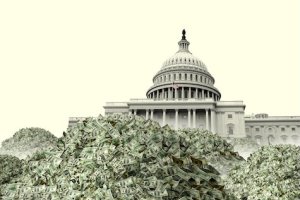
Less capital, more risk, familiar consequences. The latest move on big-bank rules suggests that too big to fail was never solved, only deferred.
The latest move to ease capital rules for large banks is being sold as a technical adjustment. It is nothing of the sort. It is another step in a long retreat from the post-2008 financial crisis promise to discipline concentrated financial power and protect the public from having to underwrite private risk.
That is the old too-big-to-fail bargain, dressed again in the language of efficiency.
The phrase itself has always misled a little. “Too big to fail” does not simply mean that a bank is large. It means that a bank is so entangled with funding markets, payments systems, counterparties, and political power that the state cannot credibly threaten to let it collapse in an ordinary way. INET was founded in the wake of the 2008 crisis precisely because that way of thinking had done so much damage. The crisis was not only a failure of regulation. It was a failure of ideas. Long before it became fashionable again to worry about concentration, fragility, and moral hazard, INET’s researchers were pressing on the unresolved problem of institutions that are so large, so interconnected, and so politically protected that ordinary market discipline does not apply to them. In 2013, Simon Johnson warned that the problem of too big to fail was “an even bigger problem” than before 2008 and argued that real reform would have required much higher capital requirements and hard limits on size. Edward Kane spent years documenting something that sits uncomfortably with the way we normally talk about financial regulation: that too-big-to-fail isn’t really a policy failure. It’s a policy choice. A continuing political arrangement, sustained by implicit subsidies, supervisory forbearance, and a remarkable tolerance for risk-taking whose eventual costs get quietly transferred to everyone else. Thomas Ferguson put the underlying logic more bluntly: heads banks win, tails taxpayers lose. All these years later, the phrase is still accurate.
Nothing that followed the crisis suggested these warnings were overstated. For years after Dodd-Frank, the official story was that the system had been fixed through stress tests, resolution plans, and tighter supervision. Under President Biden there was even a brief attempt to implement tighter regulations under Basel III. But bank opposition was fierce and these efforts were abandoned in the face of candidate Trump’s loud support of deregulation (see Ferguson et al 2026). Then came 2023. Silicon Valley Bank imploded over a weekend. Signature went down shortly after. First Republic had to be absorbed by JPMorgan in a transaction the FDIC facilitated. These weren’t the universal banks that sat at the center of 2008; they were mid-sized regional institutions. But the broader pattern was instantly recognizable. Confidence shocks spread fast. Public authorities stepped in because the alternative, finding out what happens if they don’t, was judged too dangerous to contemplate.
That history matters now, because the latest proposals arrive not after a long period of restraint; they arrive after 2023. The argument being made, that existing requirements are excessive, that they constrain credit and burden the real economy, was made before 2023 as well, and it wasn’t obviously true then either. Capital isn’t a regulatory nuisance. It’s what absorbs losses before depositors and taxpayers do. The claim that making the largest banks hold more of it somehow impairs productive lending has been examined carefully by financial economists over the past decade, and the evidence for it is considerably thinner than the lobbying intensity around the issue might suggest.
It is not difficult to understand why the lobbying has been so intense and so persistent. The implicit government backstop that comes with being systemically important is worth real money: it lowers funding costs, allows greater leverage, and compounds over time into a structural competitive advantage over smaller institutions that don’t carry the same implicit guarantee. Banks that benefit from this arrangement have strong incentives to defend it, which means they have strong incentives to resist the capital requirements that are one of the few partial offsets to it. This is not cynicism. It’s just a description of how incentives work.
These misaligned incentives were precisely what post-crisis reform was supposed to address. The promise after 2008 was not perfection, but a different balance. More capital. More resilience. Less room for institutions that benefit from implicit public support to privatize gains while socializing losses. Yet what we have seen over the last decade is a steady erosion of that settlement through exemptions, recalibrations, softer supervision, and relentless pressure from the industry itself. Each step is framed as modest. Each is defended as pragmatic. The cumulative effect is something else entirely: a gradual restoration of the worldview that prevailed before the crash. The logic has become familiar. In good times, large financial institutions insist they are dynamic engines of growth burdened by excessive rules. In bad times, they become fragile utilities whose disorderly failure would be catastrophic for everyone else. They want freedom when profits are at stake and forbearance when losses loom. That is not an accidental contradiction. It is the operating logic of a system in which private power remains heavily backstopped by public credibility.
Policymakers have never really grappled with that distortion. After 2008, there was a brief window when it seemed like they might have to. It closed fairly quickly. What followed was not a reckoning with concentrated financial power but a decade-long negotiation over how much of the post-crisis reform architecture could be quietly walked back before anyone noticed (see Ferguson et al 2020). The current proposals are the latest installment of that negotiation.
That is why the latest move matters. It is not just about a few percentage points of capital. It is about what regulators think they have learned from the last twenty years. And the answer, depressingly, seems to be: not enough. We are again being told that the largest banks can be trusted with more discretion and thinner buffers, even after repeated episodes in which the public has been asked to absorb the fallout from private excess.
The unresolved question after 2008 was whether the United States would truly confront the power of institutions that had become too large, too connected, and too politically insulated to discipline in any ordinary way. That question was never answered. It was deferred.
It remains unanswered now.
And every time policymakers choose to ease the constraints on the largest banks before the structure of dependence has changed, they answer it in practice anyway.