As Senate Democrats prepare to choose their leader, new campaign finance data reveal a stark divide between Chuck Schumer and Chris Van Hollen. The contrast raises a fundamental question about the party’s future: whose interests will shape its agenda?
Senate Democrats are currently slated to choose their leader for the next Congress on December 1st in a secret ballot. Usually such exercises are routine, but not this year.
The sense of drama is palpable: Because the Democrats will have a heavy majority in the upper chamber, their leader is guaranteed vast leverage over both process and policy. But for the first time in many years, the strenuously maintained façade of unity that customarily cloaks intra-party differences has cracked wide open.
After noisy debates all through the 2026 election cycle over whether the Party needs a sharp change in direction, Senate Democrats are split over the path forward. New York Senator Charles Schumer, their long-time leader, faces an open challenge from Chris Van Hollen, the senior Senator from Maryland. Progressives such as Bernie Sanders, and incoming Senators Peggy Flanagan and Abdul El-Sayed, have lined up behind Van Hollen. They and others want sweeping changes in health care, policies toward AI data centers, and worker rights. They also seek a major redirection in foreign policy with respect to Israel and the undeclared US war with Iran.[1] Party stalwarts in favor of less drastic policy swings are rallying around Schumer, often very quietly.
Caught in between are many incoming Democratic Senators who were elected promising to be aggressive challengers of the status quo. The need to make a choice is plainly putting candidates like incoming Texas Senator James Talarico, Maine’s Troy Jackson and others in an awkward spot. Some Senators widely considered to be possible presidential candidates, such as Georgia Senator Jon Ossoff, are also in the spotlight.
Until all the data becomes public, a full accounting of Democratic fundraising in the 2026 election is impossible to present. We are skeptical of current media tales of a great blue wave of voters battering down cyclopean walls of red money, but it is impossible to know for sure until final campaign reports become available in December (or even later).
What is clear already, though, is that many victorious Democrats benefited heavily from funds Schumer raised and their own homegrown networks of billionaires whose policy preferences differ little from the New York Senator’s but are light years away from, say, Sanders’. (The example is not picked at random. In the next Congress, the Vermont Senator is slated to chair a key Senate committee responsible for health policy. His recent announcement that he would introduce legislation to implement Medicare for All in stages cratered stocks of insurers and other firms in the industry, including United Health Care.)
Some Senators are ducking a choice, alluding to unspecified “questions” they want answers for or even punting entirely by resonantly announcing they will not support Schumer but may not vote for Van Hollen.
Their dilemma is easy to understand. Schumer is not merely a representative of the status quo in the Democratic Party – he is its living incarnation. The start of his political career coincided with the dollar’s phoenix-like revival from the collapse of the Bretton Woods international monetary system. Then a young member of the House of Representatives, Schumer quite deliberately sought out membership on the House Banking Committee, making no bones about his desire to cultivate close relations with Wall Street.
In the following decades both Wall Street and Schumer prospered mightily. As New York emerged as the world’s financial center on a scale beyond anything it had ever attained before, Schumer’s links with financial markets ripened. In 1998, he moved to the Senate. Though sharply criticized for uncritically supporting Wall Street in the run up to the 2008 financial crisis, Schumer’s fundraising prowess propelled him steadily forward. Eventually he took over from Nevada Senator Harry Reid as Senate Democratic Leader. Today, he presides over a far-flung network of campaign fundraising vehicles, including giant Super Pacs that make heavy use of dark money, and steadily revolving door interchanges which family and friends cycle lucratively through.
Which leads to an interesting question. In the spirit of our earlier works (Ferguson, Jorgensen, and Chen, 2022) that analyzed Congressional leaders and presidential candidates in 2016 and Congressional leaders this year (Lalisse, 2026), we think it is timely to compare the shape of Schumer’s donor distributions with those of Van Hollen.
The data we present here are put together along the same lines as in our earlier studies. The crucial point is that we aggregate contributions from the same people and firms to reveal the true size distribution of donors nourishing each campaign.
We have already observed that these tabulations are necessarily incomplete. A full list of the campaign spending vehicles for each Senator that we surveyed appears in our Appendix. Coverage is reasonably complete through reports covering (not filed by) mid-October, though long experience teaches that these interim reports normally contain sizeable holes.
But we also know from previous work that in most campaigns shapes of basic donor distributions change only marginally in the later weeks of campaigns, in contrast to totals, which soar. No matter when you surveyed Bernie Sanders’ campaign filings, for example, you can be sure that his campaign finances will tilt as lopsidedly toward small donors as Figure 1’s final 2016 summary shows.
Figure 1: Size distribution of contributions for congressional leaders (Pelosi, Ryan, McConnell, and Schumer) and presidential candidates (Clinton, Trump, and Sanders) in the 2016 election cycle.
Adapted from Ferguson, Jorgensen, and Chen, Structural Change and Economic Dynamics 2022.[2]
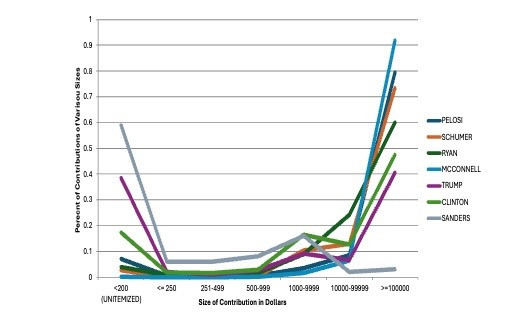
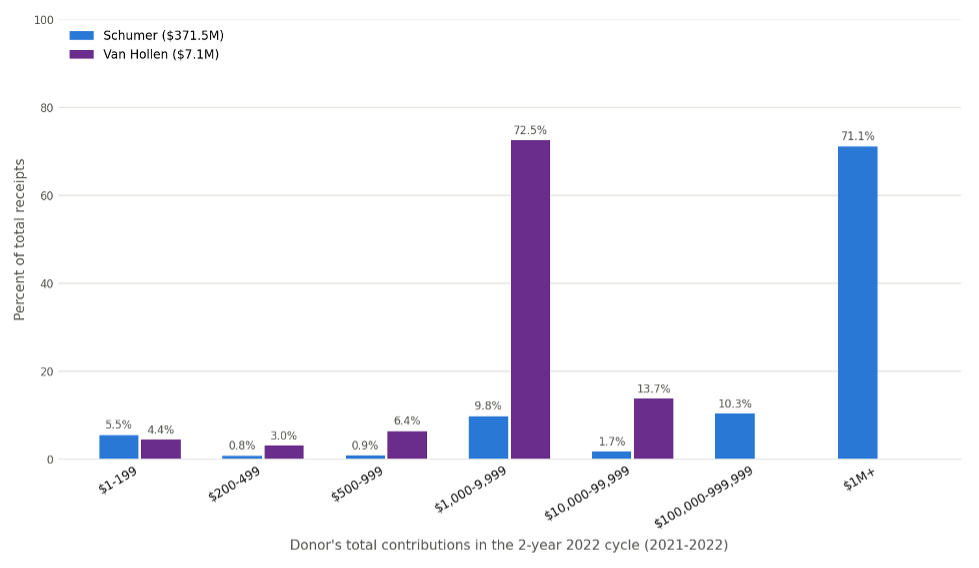
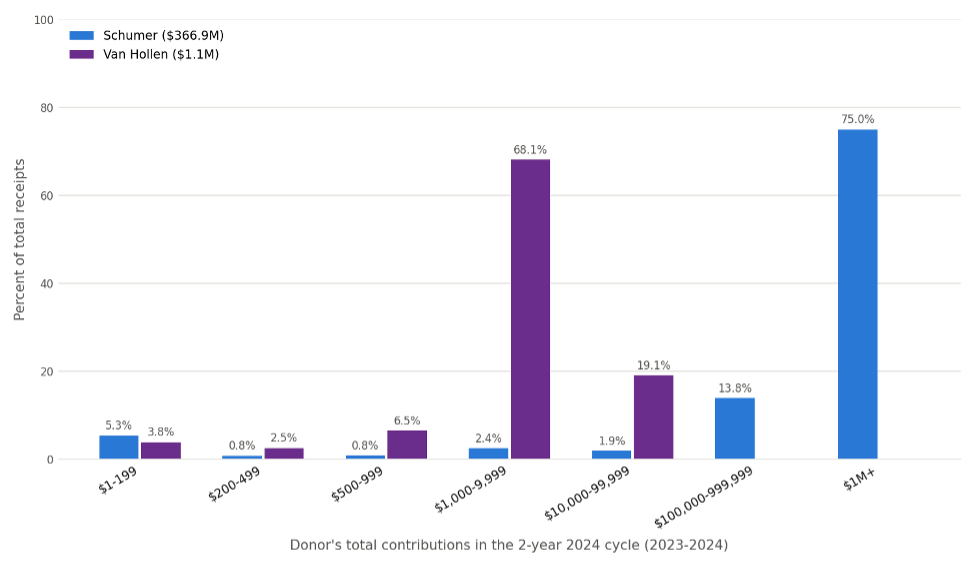
Here, then, is our comparison of donor patterns for Schumer and Van Hollen, run across the last three election cycles, since Senators are elected for six year terms and that affects money flows in between. Figures 2, 3, and 4 show why pictures are worth a thousand words. As Lalisse showed earlier this year, the new normal of Schumer’s donor distribution is now massively weighted toward donors proffering not total contributions of $100,000 or more as in the figure for 2016 above, but a million dollars or more.
Figure 2: Schumer and Van Hollen Donor Distributions 2022
Source: Authors’ calculations from FEC data
Figure 3: Schumer and Van Hollen Distributions 2024
Source: Authors’ calculations from FEC data
Figure 4: Schumer and Van Hollen Donor Distributions 2026
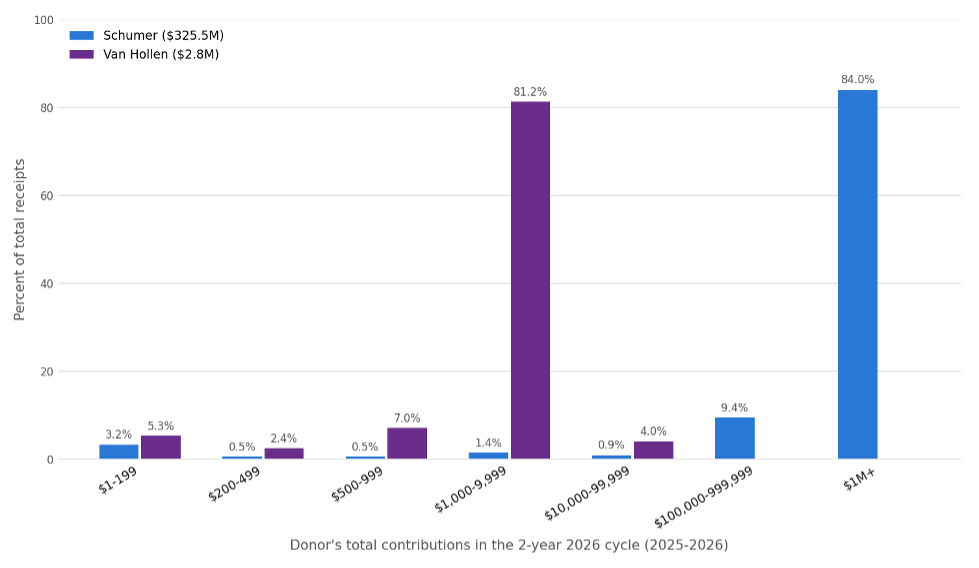
Source: Authors’ calculations from FEC data
Van Hollen’s distributions are far more modest. The response that of course the campaign treasury of the Majority Leader will be bigger slides past the crucial point: where the money comes from from. Only one of the two contestants depends on fundraising from the super-rich. That is not Van Hollen.
Appendix
Schumer’s financing is Baroque even by Congressional standards as we detailed in several earlier discussions (Ferguson, Jorgensen, Lalisse, and Chen, 2026); (Ferguson, Jorgensen, and Chen, 2026); Lalisse, 2026). Van Hollen’s is much simpler – he has no Super Pac and no cognate dark money vehicle.
We began by rounding up the political action committees associated with each candidate. These are of several types, subject to differing regulations and filing deadlines. They include formal campaign committees, leadership Pacs, joint fundraising committees, and super Pacs. The first three account for much smaller flows than the last category. For Schumer the committees include the Friends of Schumer; Impact, his Leadership Pac; the Senate Majority Pac, which is a Super Pac; and WinSenate, another Super Pac. Van Hollen’s are his campaign committee, Van Hollen for Senate; Victory Now Pac, his Leadership Committee, and a joint fundraising committee, the Van Hollen Victory Fund.
We make strenuous efforts to avoid double counting. We treat transfers between a candidate’s Pacs as duplicate transactions (WinSenate’s total income was from the Senate Majority Pac). Joint committees transfer their income to other Pacs in itemized form, and we treat the receipts of the endpoint committee as the original money, not the contributions to the joint committee. This process can be trickier than we have space to recount, but it is essential to avoid double counting.
The enormous amounts of dark money flowing through Schumer’s Super Pac vehicles, the Senate Majority Pac (“SMP”) and the affiliate organization called WinSenate, require a special word. As discussed at greater length in Lalisse (2026), a large share of their receipts originate from untraceable contributions routed through a group known as Majority Forward. Depending on the election cycle, that renders anonymous the donors of anywhere from a fifth to a third of the Super Pacs’ receipts. Though in principle it is possible to disaggregate the gargantuan sums sent on by Majority Forward, the organization declines to declare any of its contributors on its annual tax forms and the accounting practices enabled by the Supreme Court’s Citizens United ruling and other court decisions make it impossible to trace these giant lumps of cash to their origin. As a result, Majority Forward is treated as a single hundred million-dollar donor, an elision rendered essentially inescapable by the nature of the data. Experience and prior analyses of the dark money landscape suggest that the types of donors who contribute to dark money groups cluster in the $100,000 to million-dollar tier, so not much is lost for our tally of contribution sizes.
- 1. Van Hollen supports limiting US sales to Israel only for defensive purposes. He has not proposed a complete cutoff of support and supports its right to exist and defend itself.
- 2. Ferguson, T., Jorgensen, P., Chen, J., 2022. “How money drives US congressional elections: Linear models of money and outcomes.” Structural Change and Economic Dynamics 61. 527-545.