The upheaval in Maine’s Senate race has focused attention on candidates and party leaders. Less noticed is what the campaign finance data reveal about the state’s Democratic Party and its structural dependence on national organizations and large out-of-state donors.
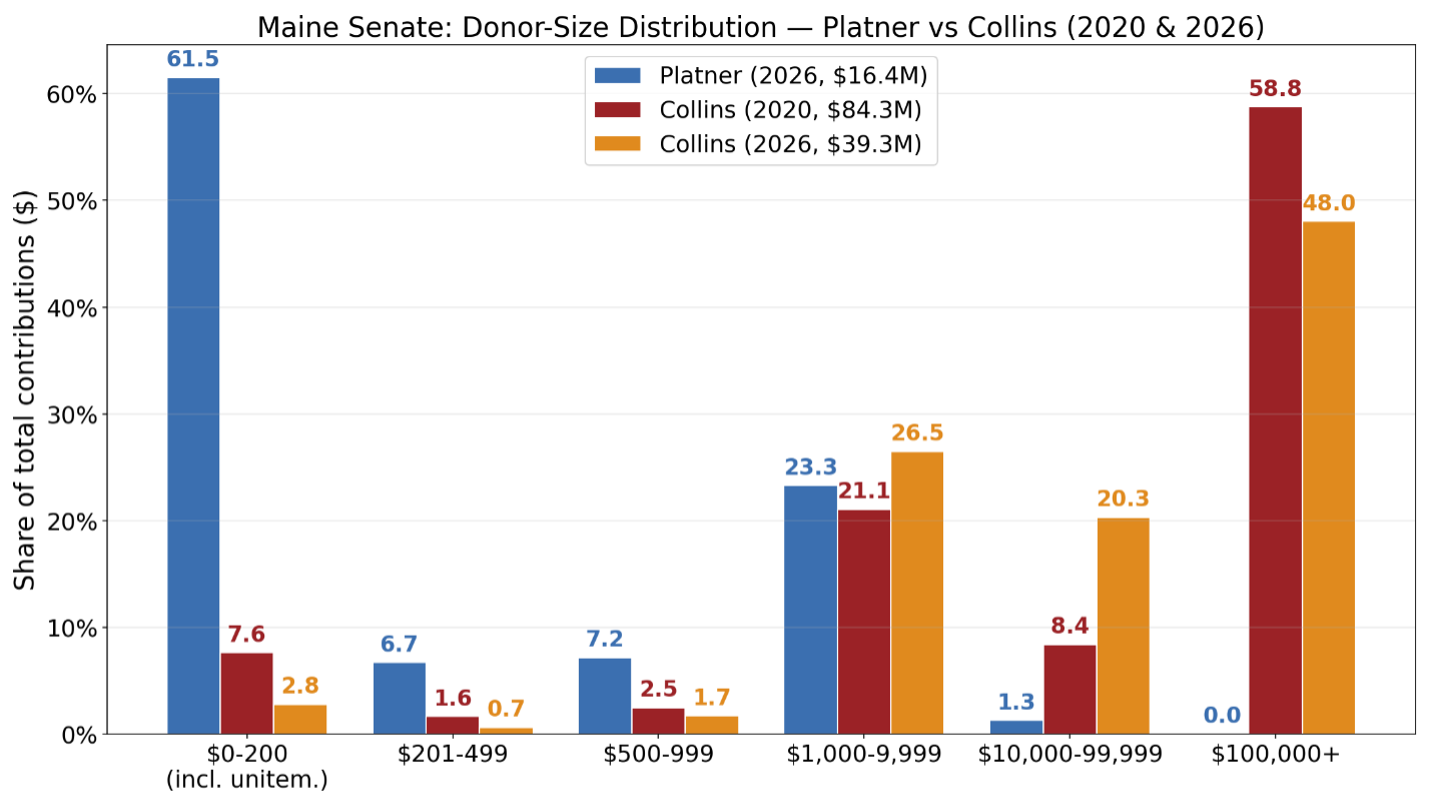
Barely a fortnight ago, Maine’s Senate election showed all the hallmarks of a classic match-up between David and Goliath. In the giant’s role stood incumbent Republican Senator Susan Collins, backed by a tidal wave of outside money mostly from very big donors, including almost a 100 billionaires or their spouses. The David challenging her was Democrat Graham Platner, who had already forced the withdrawal of Maine Governor Janet Mills, who had also sought the nomination. Platner’s campaign financing profile was the polar opposite of both Collins’ and establishment leaders in both parties: Essentially no large donations, quite like the distinctive profile of Vermont Senator Bernie Sanders we have analyzed before. See Figures 1 and 2 and for Sanders, Figure 4.
Figure 1: Big Money in Maine Senate Elections Round 1
But that was then; this is now. As a blockbuster movie about a legendary Greek hero starts swallowing midsummer America’s cultural space, Maine suddenly one-upped Hollywood. The state borrowed from another celebrated Greek sage, Heraclitus: A scandal broke, and suddenly everyone discovered that you could not step twice into the same Senate election.
The bitter debates occasioned by Platner’s 11th hour withdrawal have dominated media coverage ever since. Meanwhile the New York Times and other media report that Maine Democrats are firmly resolved to reject efforts by out of state leaders of the national Democratic establishment, such as Senate Minority Leader Charles Schumer to influence the choice of a new nominee. But we were interested to see that, rather like another famous 2024 case, party leaders decided against a quick “firehouse” primary to let the voters decide. Instead, the leaders chose to select a new candidate at a convention of 601 people, that would include 101 members of the Maine State Democratic Committee.
We have no special insight into the mindsets of Maine Democratic leaders. But after seeing the Times article about how unwelcome Senator Schumer is said to be, we thought the financing of the Maine Democratic Party might merit closer inspection. As ever, we make the move that other political money analyses don’t: we sum contributions from the same people and organizations to show the true shape of donor profiles. At a glance, one can see the extent to which big or small money dominates.[1]
State parties are somewhat different animals from election campaigns of individual candidates. The former, for example, are likely to show at least some small donations. But virtually every case we have scrutinized also shows inflows of really large sums of money, from donors both in and out of state. The size of those donations vary by circumstance and urgent need, with money from national party organizations often critically important, especially in peripheral states like Maine, that does not have Wall Streets or casinos or much high tech of its own to tap.
We are not exactly astonished, accordingly, to discover that the two largest inflows of money into the Maine party come from organizations affiliated with the Democratic National Committee and the Democratic Senatorial Campaign Committee. See Figure 2.
Figure 2: Contributions by Donor Size – Maine Democratic Party 2025-2026 Election Cycle
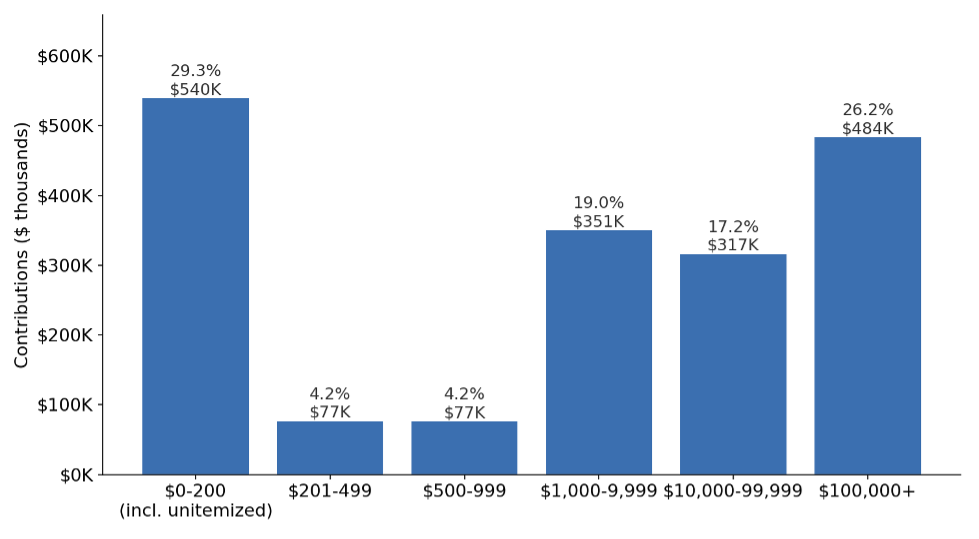
Source: Authors’ calculations from Federal receipts of the Maine Democratic Party (FEC committee C00179408), 2026 cycle, covering January 1, 2025, through May 31, 2026. Bars show net giving per donor; refunds are subtracted from the donor’s total. Eight donors whose giving nets to $0 or less are excluded. The entire $100,000+ bin consists of two national party committees: the DNC ($272,687) and the DSCC ($211,758). Total: $1,847,198.72.
These are, of course, essentially out of state contributions, like most of the rest of the big money taken in by the party, as Figure 3 shows.
Figure 3: Contributions by Donor Size and Origin – Maine Democratic Party 2025-2026
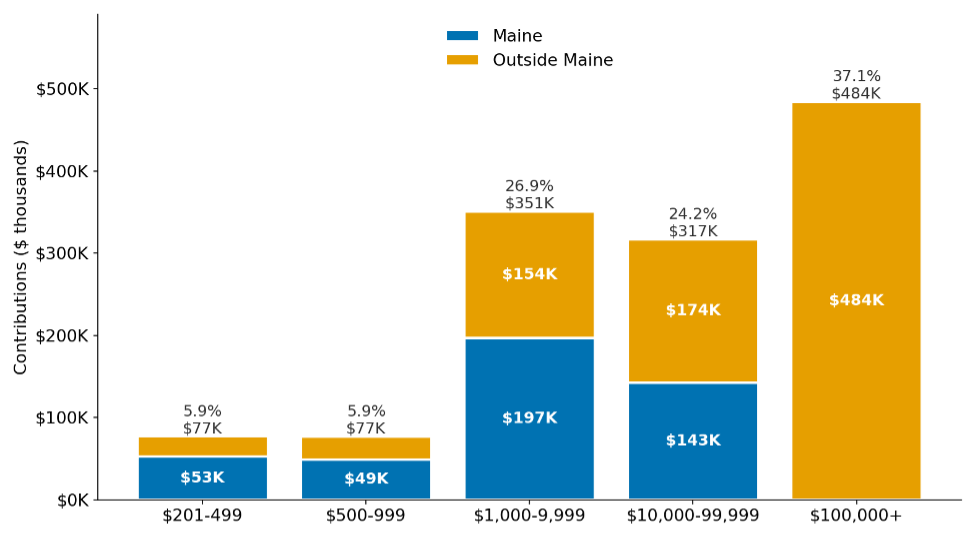
Source: Authors’ calculations from Federal receipts of the Maine Democratic Party (FEC committee C00179408), 2026 cycle, covering January 1, 2025, through May 31, 2026. Bars show net giving per donor, split by the donor’s state; party committees are included. A donor is coded Maine if ANY of their records carry a Maine address. The $0–200 bin is excluded because it is dominated by $522,582.52 in unitemized money, which carries no geography, so a state split of that bin would describe only its small, itemized sliver and mislead. Among the $1,306,772.21 given by donors above $200, Maine accounts for $441,305.75 (33.8%) and out-of-state donors $865,466.46 (66.2%). The share flips with size: the $201–999 bins run roughly two-to-one Maine, while the entire $100,000+ bin is out-of-state — the DNC ($272,687) and the DSCC ($211,758).
It is obvious that the party leans far more heavily on big donors than Platner did, even if the degree of dependence pales by comparison with parties in other, richer states. The dependence on out-of-state funds is equally evident.
But a real cluster of small donor contributions also shows. We are not dealing with a Northeastern cognate of, for example, Senator Mitch McConnell or Senator Schumer himself. See Figure 4, from our earlier analysis of leaders of both parties in 2016. Like Donald Trump in 2016, the Maine Democratic Party’s campaign finance profile displays a “barbell” construction, with a mix of small and large donations piling up at both ends of the money scales.
Figure 4: Dominance of Big Money
Size of Contributions of American Political Leaders 2016
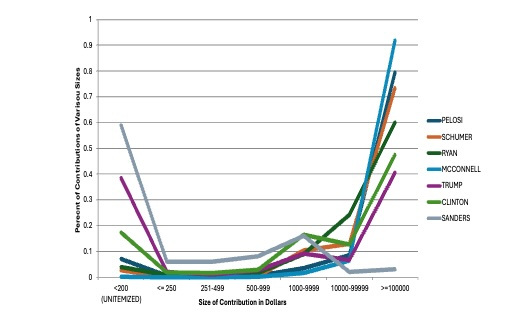
Adapted from Ferguson, Jorgensen, and Chen Structural Change and Economic Dynamics 2022
The conclusion has to be that talk of the party distancing itself from the national Democratic establishment needs to be taken with buckets, not grains, of salt. The state party’s dependence on outside big money is structural, in the absence of a candidate who can capture the imagination of ordinary Maine citizens. Rather like the Odyssey, public discussion mixes poetry and truth, with the difference that Homer was blind, while American journalists and voters need not be.
- 1. For methods, see the discussion in Ferguson, Jorgensen, and Chen, “How Money Drives US Congressional Elections: Linear Models of Money and Outcomes,” Structural Change and Economic Dynamics 61, No. 2, 527-45; https://www.sciencedirect.com/science/article/pii/S0954349X19302012?via%3Dihub For the data on this piece, see also Ferguson, Jorgensen, Lalisse, and Chen, “Big Money and the Maine Senate Race: A Tale in Two Pictures,” Institute for New Economic Thinking, June 30, 2026; https://www.ineteconomics.org/perspectives/blog/big-money-the-maine-senate-race-and-us-party-competition-a-tale-in-two-pictures