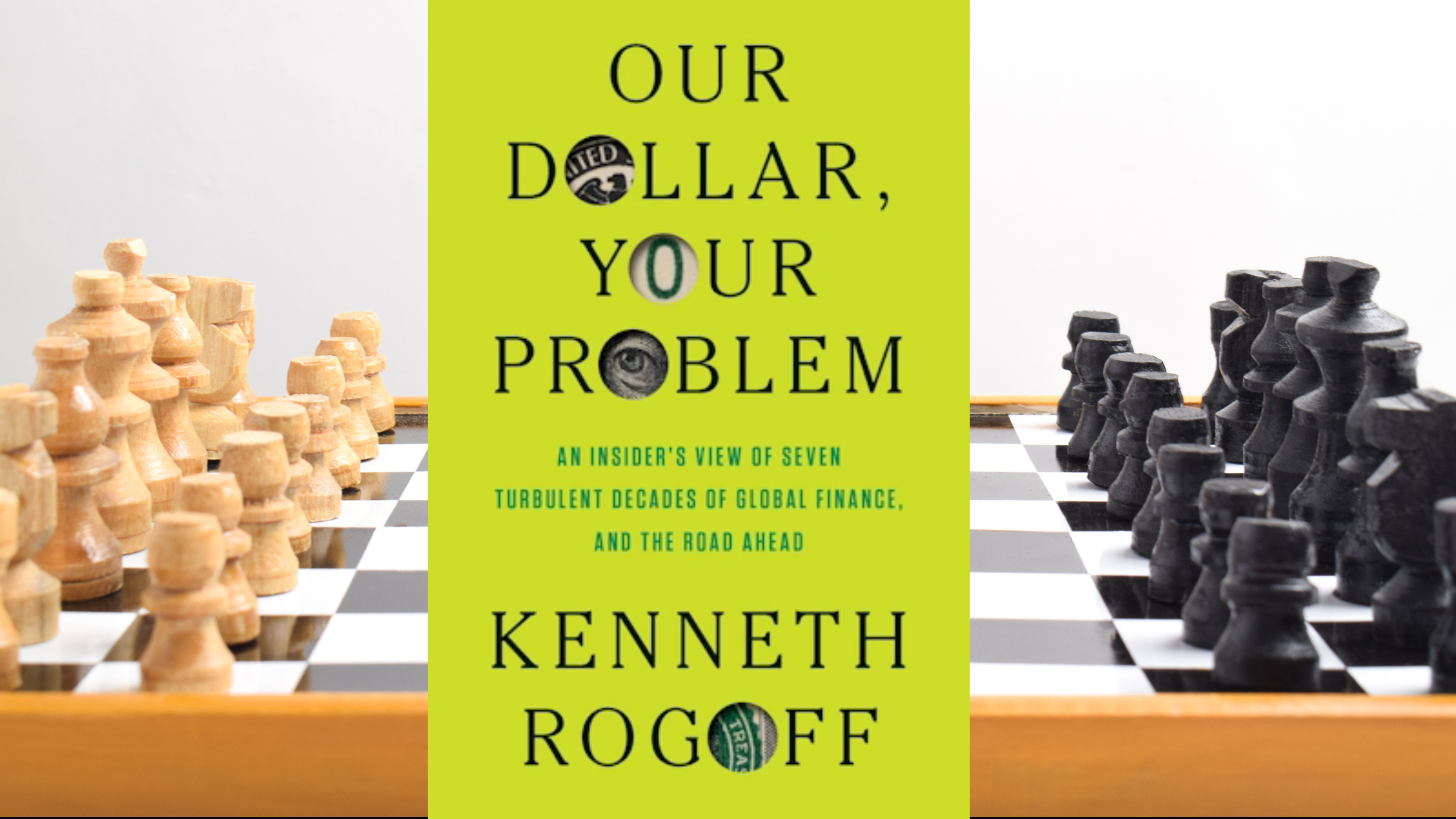
Kenneth Rogoff, Our Dollar, Your Problem: An Insider’s View of Seven Turbulent Decades of Global Finance, and the Road Ahead. Yale 2025.
This book is basically an autobiography, focused on the years of Rogoff’s academic sojourn which began at the Board of Governors and led eventually to Harvard, via Wisconsin, Berkeley and Princeton, as well as the Fed and IMF. The “seven decades” of the title apparently refers to his age; he was born in 1953. The “insider” of the title apparently refers to his role as an insider in the world of academic economics, though he makes the point repeatedly that particular papers of his were outside the current consensus when he wrote them (more on that below). The “Our Dollar, Your Problem” in the title reprises Nixon’s Treasury Secretary Connally’s comment shortly after Nixon took the dollar off gold in August 1971, and is apparently a forecast of what the Trump administration is currently doing, Nixon redux.
Rogoff’s sojourn began during the Cold War with the Soviet Union (Ch. 2), continued with the apparent ascendancy of Japan (Ch. 3), and then the excitement over the Euro (Ch. 4) as a potential alternative to the dollar. In the event, these challenges to the dollar were all brushed away and the dollar area expanded after every crisis. Today the challenger is China (Ch. 5-10). Will this challenge also be brushed away? Rogoff ends the book: “Had Russia liberalized its economy in the mid-1960s, had Japan not allowed itself to be browbeaten into a destabilizing currency appreciation in the mid-1980s, had France not insisted on including Greece in the euro in 2001, or had China moved to a full-fledged floating exchange rate regime in 2010’s, the dollar would likely still be on top, but perhaps not to the extent it is today.” (289) In short, the US has been lucky, but may not be lucky forever.
These events academic insider Rogoff mostly watched as a policy outsider, since he was more focused on finding an angle for an academic contribution publishable in a “top” journal, as he climbed the academic ladder. Now he is at the top of the ladder. After the chronology of Chapters 1-10, Chapters 11-27 shift to a thematic organization, reporting his present views on a wide range of issues under academic debate. When you are on top, you are expected to have a view. But there is more to it than that.
As a sometime intellectual biographer myself, I note the repeated chess analogies sprinkled throughout the book, and take them more seriously than Rogoff himself does. Indeed I would suggest that his early chess career, starting in high school, is the important intellectual formation we need to have in mind as the lens for understanding the moves in his second career as an economist. I have already mentioned his self-proclaimed penchant for bucking consensus. In chess everyone knows the standard openings, so to win you need to come up with a new move (on offense) or find a way to defend against your opponent’s new move (on defense). If it works, everyone studies the game and adds it to their own chess repertoire.
That’s apparently how he understands the academic game as well, albeit perhaps subconsciously, and he was good at playing that game as well. Tenure at Harvard is basically the academic equivalent of international grandmaster status in chess, a status he achieved in 1978 just as he was starting his academic career. In chess, tournaments are where you test your skills against your rivals. In academia, conferences and workshops play an analogous role, and we know who won by subsequent publication placement. (Not nearly as objective as checkmate!) Throughout the book, we hear repeatedly about some of these academic rivalries—versus Stiglitz, Greenspan, Dooley et al, Rey, Summers, Krugman—with brief summaries of the moves that Rogoff made in crucial games. Games with lower ranked players are relegated to footnotes, as Herndon et al (329 n. 14) which challenged the empirical basis for his claim that economic growth suffers when government debt exceeds 90% of GDP. You might think that this belongs in the text, given the importance of the subject, notwithstanding the ranking of the player.
In academia, the openings that everyone knows are the classic papers in the field, papers that are on all graduate student reading lists. For international finance, the Triffin dilemma and the Mundell trilemma are foundational, for example, and Rogoff accepts both of these as time-tested openings (as I do not) even as in his policy work he comes to realize limits to their real-world applicability. At the IMF “more than at any other time, it struck me how messy the real world is compared with the models we economists have developed. Still, having a firm grasp of core economic models proved quite useful as a frame of reference across endless days of policy debate…Not only do standard open-economy macroeconomic models help crystallize some important truths, but knowing them makes it much easier to remember what you said the previous day!” (148-149) Even in the policy world, Rogoff remains an academic insider, playing the same openings.
It is clear that Rogoff’s worldview was permanently shaped by his undergraduate economics training at Yale (meaning Tobin) and then graduate training at MIT (meaning Dornbusch). He is never critical of either one; quite the reverse, they are his standard openings in academic and policy debate throughout his life. Though he gives lip service to the ever-present innovation in the actual world of finance, it is apparently not innovation that requires any response in the world of theory. He knows about the offshore Eurodollar (119) and central bank liquidity swaps (231), but does not appreciate their significance—i.e. the dollar system is a global system. Notwithstanding globalization, Rogoff’s world is one of separate nation states, each with its own autonomous policy, both fiscal and monetary. Repeatedly he endorses flexible exchange rates as a way of making room for national differences in policy, “blowing off steam”. (Notably, he is an elasticity pessimist, doubtful that exchange rates have much effect on the balance of trade.) He is an IMF guy (“It’s Mostly Fiscal”) not a BIS guy (“Banking Is Swapping”), talking to finance ministers not central bankers.
For him the main source of instability is bad policy. In the developing world, especially, governance failure is a much bigger problem than market failure (versus Stiglitz). And the same is true even in the United States. Fed chair Miller was case in point, focusing excessively on short-term interest rates: “That is akin to looking only one or two moves ahead in chess” (252). The problem is endemic, and the reason is political interference with monetary policy.
For Rogoff, the ideal monetary policy is an inflation-targeting regime run by an independent central bank, with a flexible exchange rate to absorb volatility, and this is true whether you are the United States or Argentina. Raise rates when inflation rises above the target, lower them only when it falls below. Too low for too long, and you get a credit expansion that ultimately ends in a bust, which unfortunately is the pattern we see repeated across history and across countries.
The main reason for political interference, in Rogoff’s mind, is fiscal irresponsibility. Governments want to run deficits, which means they need to issue debt, and they want the central bank to help by monetizing the new debt. In his mind, the eventual result of such monetization is inflation. The whole point of inflation targeting is to prevent the Treasury from using the central bank as its piggy bank. It’s not a very strong constraint however, as he realizes, which explains the idee fixe of the entire book. Repeatedly he warns of the danger of excessive government debt. For him that is what the Triffin dilemma is about—foreigners losing faith in US debt and dumping it on world markets.
This is an important point. Rogoff’s starting place is the capital market not the money market, and his worry is always about solvency not liquidity. Indeed he sees lender of last resort (or more modern “market maker of last resort”) as essentially fiscal, just more indirect. For him the dollar is in demand because it is the global “safe asset”, not because it is the global means of payment (see Table 1, p. 10). And should it prove not to be safe anymore, i.e. when inflation threatens its value, global investors will switch to something else, causing collapse of bond prices and soaring long term interest rates.
If that were to happen, it might not be the end of the dollar system, on account of “network” effects. If everyone else is quoting prices in dollars, and settling trades in dollars, then the dollar as a “vehicle currency” may survive. But the ability of the US government to sell debt to foreign investors will be seriously impaired. That scenario is apparently what keeps him up at night, and has done so for quite some time.
The ghost in this particular machine is Charles P. Kindleberger, though it appears that Rogoff is not much aware of it. “I did take Charles Kindleberger’s course when studying at MIT, but like all the other graduate students, I was mainly absorbed in learning the technical nuances that were essential for publishing in top journals, and did not yet fully appreciate how important his broad-based historical research would turn out to be” (330, n 22). He gives Kindleberger credit for pointing out how the US was operating as “Banker to the World” (225), but for him that means issuing safe US Treasury bonds and buying risky foreign equities. For Kindleberger, by contrast, it was about foreign companies floating dollar loans in New York capital markets, and foreign banks holding their dollar reserves in New York private banks. In a word, it was about the dollar as global means of payment, not as global safe asset, liquidity not solvency.
Several other places in the book, you can hear the influence of Kindleberger. The notion that the dollar is global “lingua franca” for example (314 n. 6, not listed in the index), and also the emphasis on the Lewis model of labor surplus (Kindleberger, Europe’s Postwar Growth, the role of labor supply, 1967). McKinnon and Mundell are singled out as outliers advocating fixed exchange rates (111), but actually Kindleberger was there first. Unbeknownst to Rogoff apparently, Kindleberger’s Europe and the Dollar (1966) was a response to Triffin, and Kindleberger hoped the SDR would not replace the dollar (as his MIT colleague Modigliani hoped, 175) but rather would support the organically developing dollar system that policy makers seemed intent on destroying. For Rogoff, the dollar emerged as the dominant currency because of US military dominance (Ch. 23), and thenceforth has been supported by network externalities. For Kindleberger, dollar dominance arose from business practice and was only regularized and endorsed by political authorities at Bretton Woods.
For Kindleberger the world is not a set of independent nation states with policy autonomy. For him there is one world money market and one world capital market where short and long term rates respectively are determined. US monetary policy operates on that global system and, even without US policy mistakes, it is subject to the inherent instability of credit that plagues all credit systems. That’s why there are central banks, to put a floor on inherent instability. The dollar being the ultimate global currency, the Fed de facto emerges as global central bank, as the Bank of England was during the sterling period.
For Kindleberger therefore the Fed is fundamentally a bank, a banker’s bank, whereas for Rogoff it is fundamentally a government bank, and in his mind the Fed’s balance sheet is just an extension of the Treasury’s. Just so, he argues that paying interest on reserves makes them “a lot more like interest-bearing short-term Treasury bills than paper currency, which pays no interest.” (258) The central banker’s notion of a corridor system, creating an outside spread by offering both a deposit rate and a lending rate in order to control the market rate which bounces around inside that spread, is nowhere to be found in Rogoff’s account.
Rogoff identifies as an insider, and in multiple dimensions. Repeatedly he identifies himself as “someone who is generally in favor of greatly expanding the social safety net in the United States” (273) but is then careful to separate himself from “leftists” and “progressives” who want to use the state balance sheet for this purpose. In his mind Stiglitz is maybe the most important voice in this regard, because he is also an insider in the academic game. Chapter 15 contrasts what Stiglitz calls the Buenos Aires Consensus which went nowhere with a “Tokyo Consensus” that actually emerged in policy practice. Repeatedly Rogoff self-identifies as “minority” (x), “not the conventional view” (66), and “pretty far outside the consensus” (268); presumably that’s how it felt to him, even as to outsiders (like myself) he appears more or less the epitome of orthodoxy. Apparently he sees academic consensus as fundamentally unstable, destabilized by powerful actors who court attention (not dissimilar to the problem of fiscal irresponsibility that causes financial instability). Not for him. He just keeps playing the game, mostly defense, but on occasion, when the opportunity arises, on offense.
In conclusion, I draw attention to two fascinating pages on the influence of AI on chess (259). He was there at the beginning, soundly beating one of the first computer chess programs in 1976 at MIT, but he could see the future and that’s one of the reasons he switched to economics. As AI developed, eventually the computer could beat even Kasparov but—and here is the point that drew my attention—chess players learned from AI and changed their games. And as AI improved even more, they changed again. I end with the question, is economics like that? And to the extent that it is a kind of technical arms race, is it a good thing? Is it making economics better, or just giving more ways to rationalize what policymaker overlords want to do for their own reasons?
Rogoff says he did not appreciate Kindleberger when he was young because he was trying to learn the moves that would get him into the top journals. Now as a teacher, he seems to feel the responsibility to teach those moves, hence his enthusiasm for Diamond-Dybvig (150) even as he has learned better. The young are clever, the old are wise. If the old do not convey their wisdom, how does knowledge progress? Economics is not chess.