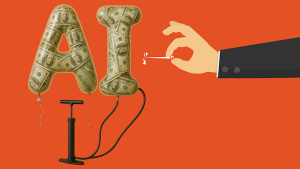
Storm argues the AI data-centre investment boom is creating a bubble that will be socially and financially expensive when it pops.
The AI industry is betting that ‘scaling’, i.e., adding more and more data, GPUs, compute infrastructure and dollars, will lead to machine superintelligence or Artificial General Intelligence (AGI) — which in turn will lead to exponential growth of output, productivity and profits for the industry and the larger American economy. Focusing on AGI and generic LLMs, the point of this paper is plain: AI’s ‘scaling’ strategy must fail and the AI data-center investment bubble will pop. The paper identifies four bottlenecks: (1) the planned $5 trillion investment in data center infrastructure (during 2026-2030) is not going to pay off; AI revenues will not increase enough and AI inference cost continue to rise faster than revenues; (2) AI firms will have to resort to hyper-scale borrowing from banks and investment-grade bond markets to fund their capex; this hyperscale borrowing will create a ticking time bomb on the balance sheets of AI firms, because the core capital expenditure on specialized GPUs and server risks becoming economically obsolete within two or three years; (3) it will be impossible to build the projected data center infrastructure fast enough, because upstream suppliers — producing everything from copper wire to turbines to transformers and switchgear — will run into labor shortages, long waiting times for power grid connections, material bottlenecks and regulatory blowback; and (4) the strategic bet of frontier AI firms that AGI can be achieved by building ever more data centers and using ever more chips is already going bad; AI products will continue to be untrustworthy for high-stake usage. As a result, the magical projections of exponential growth, which defy economic and financial logic and fatally ignore unforgiving real-world constraints will turn out to be wrong. The fact that the AI industry is the main source of growth in an otherwise sclerotic U.S. economy and is driven by a concentrated set of hyper-scalers engaging in ‘circular’ financial transactions based on aggressively optimistic long-term cash flow-generating potential should be a very serious cause for concern.